Beyond Average: Katherine Johnson and the Law of the Outlier
In statistics, an outlier is the point that refuses to sit comfortably inside the expected pattern. It is the value that makes the graph pause. It does not destroy the dataset; it reveals that the dataset was too small, too lazy, or too biased to explain the truth.
That is the heartbeat of the sixth law in Numbers Don’t Lie: the Law of the Outlier. You are not average. You were not created to be reduced to the mean. In a world that often measures people by categories, credentials, zip codes, gender, race, age, or yesterday’s results, the outlier reminds us that averages describe groups, but purpose is assigned to persons.
Katherine Johnson lived that equation long before America learned to say her name.
Born in White Sulphur Springs, West Virginia, in 1918, Johnson was the kind of child whose mind moved faster than the curriculum. NASA’s biography records that her curiosity and brilliance with numbers pushed her ahead several grades; by age thirteen she was attending high school on the campus of historically Black West Virginia State College, and by eighteen she had graduated with highest honors in mathematics and French.[1] West Virginia State University notes that she enrolled in college classes by fifteen and graduated summa cum laude in 1937.[2]
If life were only a bell curve, the world around Katherine Johnson had already written her into the margins. She was a Black woman born into the Jim Crow era, educated in a segregated system, and pointed toward a country that had not yet learned how much genius it was wasting. But outliers do not ask permission from averages. They reveal what the average was hiding.
“The average can describe where people are clustered, but it cannot define where God is calling you to stand.”
The Law of the Outlier is not an invitation to arrogance. It is a warning against false humility. Too many people confuse being different with being disqualified. Johnson’s life teaches the opposite. Difference, disciplined by preparation, can become destiny.
At West Virginia State, Johnson found more than classes; she found cultivation. One of her professors, Dr. William W. Schieffelin Claytor, recognized her gift and encouraged her toward research mathematics. Johnson later recalled that Claytor did not merely tell her she could be a research mathematician; he made sure she was prepared to become one.[2] That distinction matters. Potential without preparation is only a number on paper. The outlier becomes powerful when extraordinary ability meets ordinary discipline repeated over time.
Then history shifted. In 1939, West Virginia began quietly integrating its graduate schools, and Johnson was selected as one of three Black students, and the first Black woman, offered a place in graduate study at West Virginia University.[1] She left after one session to start a family, then returned to teaching. To the casual observer, that might have looked like subtraction. A dream paused. A trajectory interrupted. But the mathematics of purpose is rarely linear. Some equations require waiting for the right variable to enter.
In 1952, a relative told Johnson that the National Advisory Committee for Aeronautics, NASA’s predecessor, was hiring Black women as human “computers” at Langley. She joined in 1953.[1] The title “computer” can sound small to modern ears, but these women were doing the mathematics that machines had not yet mastered with trust. They analyzed data, checked equations, and converted abstract physics into decisions that could keep pilots and astronauts alive.
Within two weeks, Johnson moved from the all-Black West Area Computing section into flight research work.[1] West Virginia State says she stood out because she asked the “hows,” the “whys,” and the “why nots.”[2] That is an outlier’s habit. Average systems often reward compliance. Meaningful change begins when someone with competence also has the courage to ask better questions.
Her work arrived at the exact intersection of mathematics and national destiny. After Sputnik in 1957, the space race was no longer science fiction; it was a measure of national imagination. Johnson provided mathematics for early space technology documents, calculated trajectory analysis for Alan Shepard’s 1961 Freedom 7 mission, and coauthored a 1960 research report on orbital spaceflight, the first time a woman in her division received credit as an author of a research report.[1]
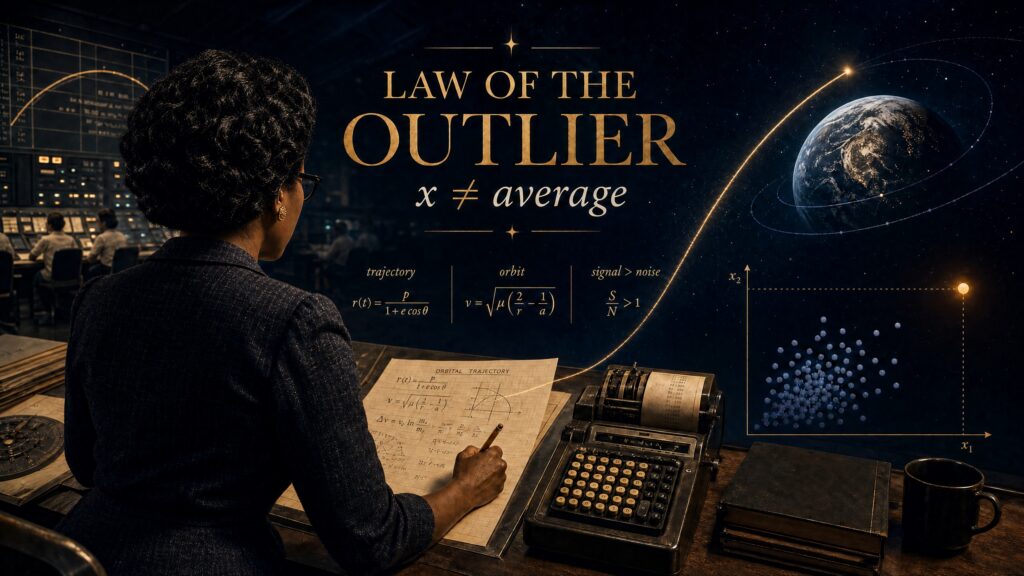
But the story that captures the Law of the Outlier came in 1962, before John Glenn’s Friendship 7 mission. NASA had programmed IBM computers to calculate the capsule’s trajectory from launch to splashdown. Yet the astronauts were wary of electronic machines, which NASA describes as prone to hiccups and blackouts at the time.[1] Glenn did not merely ask whether the machine had spoken. He asked for Katherine Johnson.
NASA records that Glenn told engineers to “get the girl” and have Johnson run the same orbital equations by hand on her desktop mechanical calculator. Johnson remembered Glenn saying, “If she says they’re good, then I’m ready to go.”[1]
Pause there. The machine represented the future. The mission represented the nation. The astronaut represented courage. But before the rocket could rise, the equation had to pass through the mind of a Black woman whose country had once tried to average her down.
That is the Law of the Outlier in full view.
| Mathematical Image | Life Principle | Katherine Johnson’s Example |
|---|---|---|
| Outlier | The point outside the expected range | A Black woman mathematician trusted with mission-critical spaceflight calculations |
| Mean | The pressure to conform to what is typical | Segregation, gender barriers, and limited assumptions about who could lead in STEM |
| Signal | The truth the outlier reveals | Genius was present where institutions had not been trained to look |
An outlier is not random noise when it keeps producing results. It is a signal. Johnson’s signal was precision. She did not demand trust as a slogan; she earned it through exactness. The spacecraft either landed where the math said it would, or it did not. In that sense, her story fits the title Numbers Don’t Lie with almost sacred clarity. The rhetoric of prejudice could distort a résumé. It could distort a room. It could distort opportunity. But it could not make wrong math right, or right math wrong.
“An outlier is not someone trying to be seen. An outlier is someone willing to be faithful to the gift even when the room has not made space for it yet.”
Johnson’s work did not end with Glenn. NASA says she contributed to calculations that helped synchronize Apollo’s Lunar Module with the lunar-orbiting Command and Service Module; she also worked on the Space Shuttle and Landsat and authored or coauthored twenty-six research reports before retiring in 1986 after thirty-three years at Langley.[1] In 2015, President Barack Obama awarded her the Presidential Medal of Freedom, the nation’s highest civilian honor.[1] West Virginia State records President Obama calling her “a pioneer in American space history” whose calculations influenced every major space program from Mercury through the Shuttle program.[2]
Yet one of the most important lessons from Johnson’s life is that the outlier is never merely individual. The Smithsonian American Women’s History Museum, reflecting on Margot Lee Shetterly’s Human Computer Project, notes that Johnson was exceptional, but not an exception. Many women worked as NASA computers, and Shetterly’s ongoing project seeks to recover thousands of names whose contributions were hidden in ordinary records.[3]
That tension matters. The Law of the Outlier does not mean, “I alone am special and everyone else is ordinary.” It means the categories we use to define ordinary are often too small. Johnson’s greatness helps us see the broader genius of Dorothy Vaughan, Mary Jackson, Christine Darden, and many others whose gifts moved through rooms that history forgot to photograph.
In business, sports, science, education, and faith, high-performing teams understand this principle. The best leaders do not merely look for people who fit the average profile. They look for hidden signal. They ask, “Who is solving the problem no one assigned them? Who is asking the better question? Who has been underestimated by the system but refined by the struggle?”
That is how families change. That is how companies innovate. That is how communities heal. That is how rockets fly.
The Law of the Outlier also has a spiritual edge. If you spend your life trying to be average enough to be accepted, you may become too small for the assignment on your life. Prime living, purposeful influence, disciplined initiative, and faithful subtraction all require a moment when you stop apologizing for the shape of your gift. Johnson did not become historic by performing uniqueness. She became historic by doing the work with such excellence that history eventually had to adjust its equation.
“Do not let the mean become your master. The Creator did not place a decimal point in your soul by accident.”
So here is the question: where have you been averaging yourself down?
Maybe you have been calling your insight “too much” because someone else found it inconvenient. Maybe you have been hiding your discipline because your environment rewards noise over precision. Maybe you have been waiting for permission to become what preparation has already been making you. Katherine Johnson’s life says the graph is not finished. One faithful point can change the pattern.
This week, practice the Law of the Outlier. Name the gift you have been minimizing. Identify the room where you need to ask a better question. Choose one equation in your life that deserves more courage, more excellence, and more truth. Then work the numbers by hand if you have to.
Because when your purpose is real, being outside the average is not a problem to solve. It is a calling to steward.