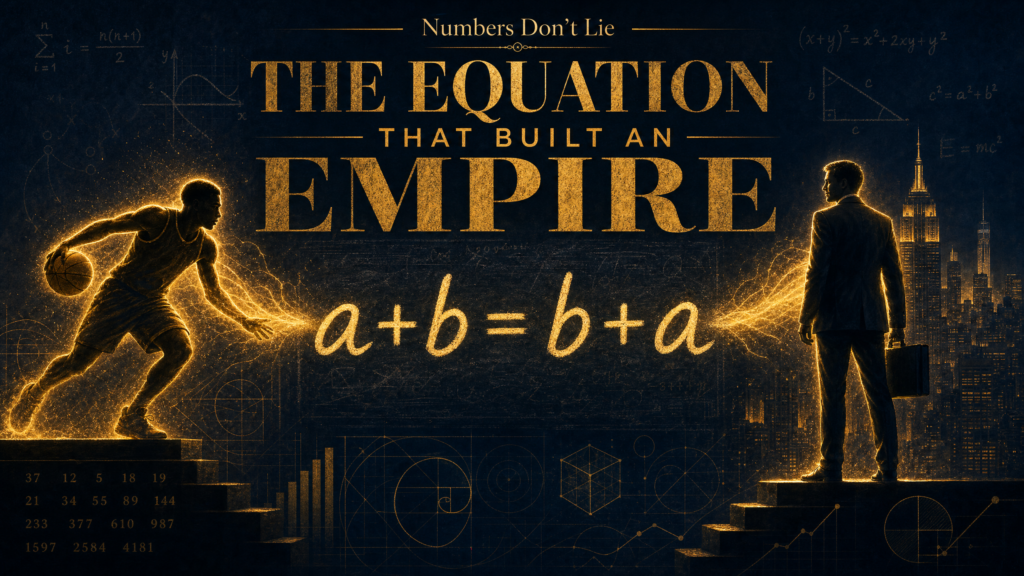
In the summer of 2003, a teenager from Akron, Ohio signed the most lucrative rookie endorsement deal in NBA history. Nike paid LeBron James $90 million before he had played a single professional minute. The world was watching. The world was expecting. And the world assumed that the story of LeBron James would be, like so many before it, the story of a singular talent consuming everything around him.
They were wrong. And the reason they were wrong is written on every chalkboard in every elementary school in the world:
a + b = b + a
The Mathematics of Mutual Investment
In Numbers Don’t Lie, Ignatius D. West unpacks the Law of Reciprocity using one of the most elegant and underappreciated truths in all of mathematics: the commutative property of addition. It does not matter which variable comes first. It does not matter who gives first, who moves first, or who speaks first. The sum is the same. The equation balances.
“Let a represent what you do to others. Let b represent what you would have them do to you. The Golden Rule says: make a equal to b. Do to others what you would have them do to you. And because the equation is commutative, it works in reverse: what they do to you should equal what you do to them. The equation balances. The symmetry holds.”
— Ignatius D. West, Numbers Don’t Lie
This is not poetry. This is not motivational language dressed up in mathematical clothing. This is a description of how the universe actually operates — in relationships, in business, in friendship, and in the quiet investments we make in one another long before the world is watching.
No story in modern sports and business illustrates this more vividly than the twenty-year partnership between LeBron James and Maverick Carter.
Two Variables, One Equation
Maverick Carter grew up in Akron with LeBron. They were not teammates in the traditional sense — Carter was a year older, a decent player, but not destined for the NBA. What Carter possessed was something rarer than a jump shot: he possessed vision, loyalty, and an understanding of power that most people twice his age had not yet acquired.
When LeBron was 18 years old and the entire machinery of professional sports was descending on him — agents, executives, shoe companies, hangers-on — Carter was the one person who sat across from him and said, in effect: I will give you everything I have, and I trust you will do the same.
That is the Law of Reciprocity in its purest form. Not a contract. Not a transactional arrangement. A mutual commitment to add to each other’s equation.
LeBron gave Carter opportunity, trust, and access. Carter gave LeBron strategic counsel, business acumen, and the kind of honest feedback that money cannot buy. Together, they founded SpringHill Entertainment in 2008 — named after the housing project where LeBron grew up — and began building what would eventually become one of the most powerful media and entertainment companies in sports history.
In 2021, SpringHill was valued at $725 million. The investors included Nike, Epic Games, and the investment firm RedBird Capital. LeBron James had become not just the greatest basketball player of his generation, but a fully realized business mogul. And Maverick Carter, the kid from Akron who was never going to make the NBA, had become one of the most respected executives in entertainment.
The equation had balanced. a + b = b + a.
The 5-to-1 Ratio and the Emotional Bank Account
West draws on the research of Dr. John Gottman, the renowned relationship psychologist, to explain why the Law of Reciprocity is not merely theoretical. Gottman’s decades of research with thousands of couples revealed a stunning finding: in stable, thriving relationships — whether romantic, professional, or otherwise — there must be a ratio of five positive interactions for every one negative interaction.
Five to one. Not one to one. Not two to one. Five to one.
The reason for this asymmetry is that the human spirit is fragile, and negative interactions carry a disproportionate psychological weight. A single moment of contempt, dismissal, or disrespect depletes the emotional bank account far more than one act of kindness can replenish it. To maintain the symmetry of the equation, one must make superabundant deposits.
Look at the LeBron-Carter partnership through this lens. Over twenty years, there have been moments of tension, of disagreement, of public scrutiny. In 2010, when LeBron made “The Decision” — the televised announcement of his move to Miami that was widely criticized as tone-deaf — Carter was involved in the production. They were criticized together. They absorbed the negative together. And then, together, they rebuilt.
They did not fracture under the weight of a single negative interaction because the account was full. Twenty years of turning toward each other, of making deposits, of maintaining the ratio — that is what allowed the equation to hold when the world was trying to break it.
Cognitive Friction: The Productive Tension of Difference
West also introduces the concept of “cognitive friction” — the productive tension that arises when two genuinely different people commit to a shared mission. He uses the partnership of Steve Jobs and Steve Wozniak as an example: Wozniak was the engineer, Jobs was the visionary. They were polar opposites. And that polarity, rather than creating division, created fire.
“Do not mistake this friction for subtraction. In a true partnership, friction is additive. It is the necessary heat generated when two distinct variables rub against each other to create a fire.”
— Ignatius D. West, Numbers Don’t Lie
LeBron James and Maverick Carter are not the same person. LeBron is the athlete, the performer, the man whose body is the instrument. Carter is the strategist, the builder, the man whose mind is the instrument. They have disagreed. They have pushed back on each other. There are documented moments in their partnership where Carter told LeBron things he did not want to hear — about business decisions, about public perception, about the long game.
That friction did not diminish the equation. It refined it. It polished it. It made the sum greater than either variable could have produced alone.
This is what West means when he writes about “Reciprocal Co-Creation” — the refusal to let the ego dominate the equation. When a becomes greater than b, when one partner begins to treat their own needs as more significant than the other’s, the equation begins to break down. The tragedy of many great partnerships — in sports, in business, in life — is not that the people involved lacked talent. It is that one variable eventually consumed the other.
LeBron and Carter have, for two decades, refused to let that happen.
The Deeper Equation: What This Means for You
You do not need to be LeBron James to understand the Law of Reciprocity. You do not need a $725 million company or a Nike endorsement deal. You need only to look at the relationships in your own life and ask an honest question:
Am I treating the people in my equation the way I would want to be treated?
“This is not optional. This is not a suggestion. This is the law of the universe, as fixed and immutable as the law of gravity. Ignore this law, and relationships often fracture. Honor it, and they tend to flourish.”
— Ignatius D. West, Numbers Don’t Lie
The Law of Reciprocity does not reward the person who takes the most. It rewards the person who gives first, gives consistently, and gives without keeping score. It rewards the person who turns toward the small bids for connection — the comment about the cardinal at the breakfast table, the text message that says “I was thinking about you,” the moment of genuine attention in a world full of distraction.
These are the small integers that, added together, create the sum of a life well-loved.
The Chalkboard Is Before You
LeBron James and Maverick Carter did not build SpringHill Entertainment because they were the most talented people in the room. They built it because they understood, perhaps intuitively, perhaps through hard-won experience, that the equation only works when both variables are fully present.
a + b = b + a.
You are the a. The people in your life — your partner, your friend, your colleague, your child, your neighbor — they are the b. The equation demands that you treat them as you would want to be treated. That you make the deposits before you need the withdrawals. That you turn toward the bids for connection before the account runs dry.
The chalk is in your hand. The chalkboard is before you.
What will you add?
This article draws on themes from Chapter 2 of Numbers Don’t Lie: Simple Mindset Math for a More Meaningful Life by Ignatius D. West, available on Amazon.